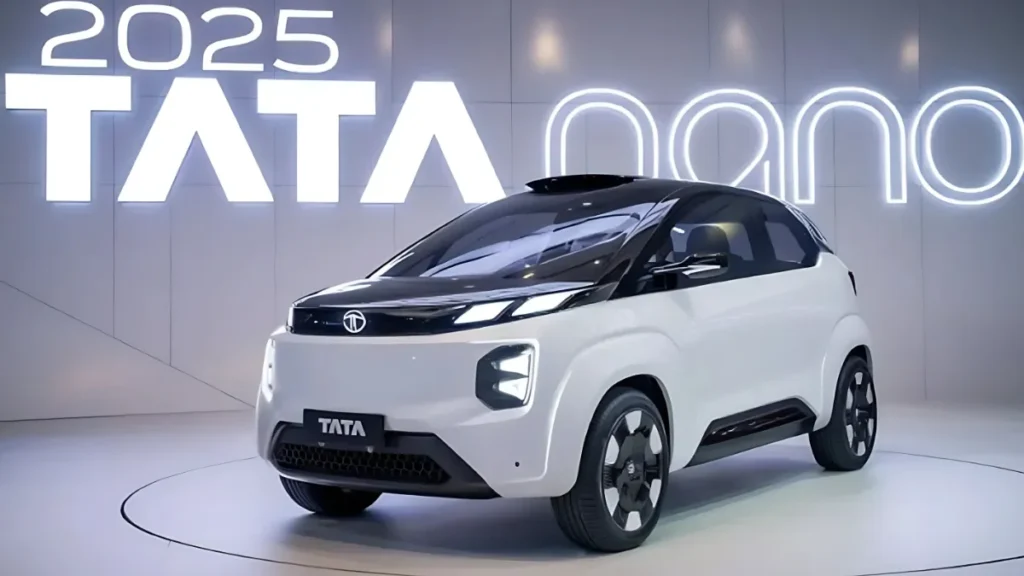
The Tata Nano, once known as the world’s most affordable car, is making a strong comeback in an all-new electric avatar. Dubbed the Tata Nano EV, this upcoming model is expected to redefine budget-friendly urban mobility with an estimated price range between ₹6 lakh and ₹9 lakh. Tata Motors aims to position it as the most affordable electric hatchback in India, catering to first-time car buyers, city commuters, and eco-conscious families.
The all-new Tata Nano 2025 will no longer just be known for its low price tag; it’s now arriving with cutting-edge upgrades like a sunroof, bold alloy wheels, a touchscreen infotainment system, and an astonishing mileage of up to 40 kilometers per liter. Here’s a detailed look at what makes the new Nano a car worth watching in the compact hatchback segment.
Tata Nano EV is expected to offer a driving range of around 200 kilometers on a single charge, making it ideal for daily use, short commutes, and running household errands in congested cities. Tata may use battery technology similar to what is currently used in the Tiago EV and Tigor EV, ensuring reliability and performance in the same ecosystem. While exact battery specs are still under wraps, industry speculation hints at a possible 17–22kWh battery pack with fast charging support.
A Stylish Comeback With Premium Design
The Tata Nano 2025 will feature a premium hatchback design with modern aesthetics. It sports a hexagonal front grille, sleek LED headlamps, daytime running lights (DRLs), and bold alloy wheels. Tata will offer the car in several vibrant new color options to appeal to younger buyers.
With a compact length of just 3.1 meters and a ground clearance of 180mm, the Nano is designed to tackle India’s congested city roads and parking challenges with ease. It’s small on the outside, but big on convenience.
In terms of design and features, the Tata Nano EV will receive a modern upgrade over its original model. It may come with a compact digital instrument cluster, touchscreen infotainment system, power windows, remote central locking, and proper air-conditioning. Safety-wise, buyers can expect essential features like dual airbags, ABS with EBD, reverse parking sensors, and possibly a rearview camera in the higher trims. These upgrades will make the Nano EV not just affordable, but also practical and future-ready.
The Tata Nano EV brings back the charm of the iconic hatchback with a sustainable twist. With an expected price under ₹9 lakh, a practical 200km range, and features that meet modern needs, it’s all set to revolutionize entry-level electric mobility in India. Keep an eye out for official announcements as Tata gears up to reintroduce the Nano this time as a clean, compact city EV.
Interior and Features
The cabin is a major upgrade over the original Nano. It features dual-tone interiors, ambient lighting, and a soft-touch dashboard finish. A floating touchscreen infotainment system supports Android Auto and Apple CarPlay, while a digital instrument cluster displays range, battery percentage, and driving modes. Electric AC, keyless entry, voice commands, and connected car functions (via a mobile app) make it feel far more advanced than before.
Powertrain and Performance
The Tata Nano EV 2025 runs on Tata’s Ziptron electric platform and offers multiple driving modes — Eco, City, and Sport — along with regenerative braking for energy recovery. It’s expected to pack a 17–22 kWh lithium-ion battery with a driving range between 200 km and 300 km per charge, depending on the variant. Fast charging support is available, allowing a top-up to 80% in under an hour.
Safety and Practicality
Tata has re-engineered the Nano’s structure for global safety standards. The 2025 model includes dual front airbags, ABS with EBD, rear parking sensors, a reverse camera, and traction control — all rare in its price segment. Though compact, it comfortably seats four adults and offers foldable rear seats for extended boot space.
Price and Market Positioning
The Tata Nano EV 2025 is priced between ₹6 lakh and ₹9 lakh (ex-showroom) for India, depending on the variant. It’s expected to compete with entry-level EVs and small hatchbacks like the Tiago EV, Strom Motors R3, and even budget petrol cars like the Maruti Wagon R or Celerio.
Key Highlights
17–22 kWh battery pack with 200–300 km range
Tata Ziptron EV tech with regenerative braking
Dual airbags, ABS with EBD, traction control
Modern digital dash and connected car tech
Price range: ₹6–9 lakh (expected ex-showroom)
In essence, the Tata Nano 2025 evolves from the world’s once-cheapest car into an affordable electric city vehicle — aiming to democratize EV ownership in India with modern safety, technology, and design features.
