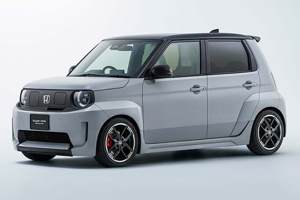
Honda is putting all its cards on the table at the Japan Mobility Show 2025, having showcased a wide array of all-electric concepts, with several set to enter production in the coming years. The automaker has now taken the wraps off another such EV concept, which will spawn a production model slated for a 2026 launch. The Honda Super ONE Prototype has been globally unveiled in Tokyo as the much-anticipated compact EV built for the mass market.
The Honda Super ONE Prototype is an all-electric hot hatch built on the lightweight N Series platform that enables sporty driving dynamics. It is essentially a futuristic concept model based on the N-One electric kei car with a wide body kit slapped on. Honda says the hot hatch has gone through extensive testing under various terrain and climate conditions and is said to offer a “new EV driving experience” tailored to make electric mobility more exciting for buyers.
Honda Super ONE: Exterior design
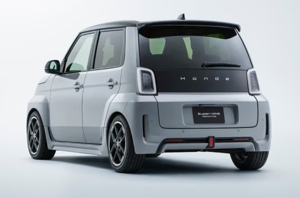
The Honda Super ONE Prototype brings compact proportions with a boxy silhouette featuring a low and wide stance. The front fascia houses round LED headlamps on a closed-off black panel with a broad front bumper below. This wraps around the car to form pronounced fenders housing wide wheels. The rear end features two slim LED taillights flanking the large liftgate, which features a huge glass section with a rear windshield wiper and the Honda lettering.
Honda Super ONE: Simple interiors
The prototype’s interiors carry a utilitarian feel with a driver-centric layout. Passengers get exclusive sport seats specially designed for the model, featuring asymmetric blue patches for contrast. The blue accents make it to the steering wheel trim and the dashboard, which brings a layered design with a touchscreen infotainment display mounted between the central AC vents.
The driver gets a horizontal instrument cluster positioned behind the two-spoke steering wheel for an uninterrupted view. The Super ONE focuses on maximum functionality, which is well reflected in Honda’s generous application of physical buttons for all vehicle functions, including HVAC, power windows, media controls, and drive selector.
Honda Super ONE: Boost Mode and driving dynamics
Honda has further equipped the Super ONE with a bespoke Boost Mode, which enables the power unit to deliver its full potential. This feature works in conjunction with a simulated 7-speed gearbox to mimic the feel of a traditional ICE-powered car’s power band when it shifts through gears. The prototype further features an Active Sound Control system that reproduces virtual engine sounds inside the cabin for an auditory experience that aims to replicate the sensation of being driven by a combustion engine.
Honda has confirmed plans to launch the production version of the Super ONE Prototype in Japan in 2026. This will be followed by a rollout for other Asian countries as well as the UK where markets are currently witnessing a rise in demand for compact EVs.
Performance and Driving Experience
- The Super ONE offers a “Boost Mode” that instantly increases power output for exciting acceleration.
- It simulates a 7-speed gearbox with virtual engine sounds and gear-shift sensations to provide the tactile and auditory feel of a traditional combustion-engine vehicle.
- Honda’s Active Sound Control adds engaging engine noises, and the car includes vibration feedback to stimulate driver senses.
- It aims to blend electric vehicle efficiency with a driving experience typically missing from most EVs.
Market and Launch
- Honda plans to introduce the Super ONE first in Japan in 2026, followed by launches in markets with strong demand for compact EVs, including Asia, the UK, and Australia.
- The vehicle was showcased alongside Honda’s other EV concepts and production plans at the Japan Mobility Show 2025.
In summary, the Honda Super ONE Prototype is an upcoming compact EV hot hatch that combines distinctive sporty styling, a fun and engaging driving experience with Boost Mode and simulated transmission, and practicality suited to urban use, targeting mass-market adoption starting in 2026.
